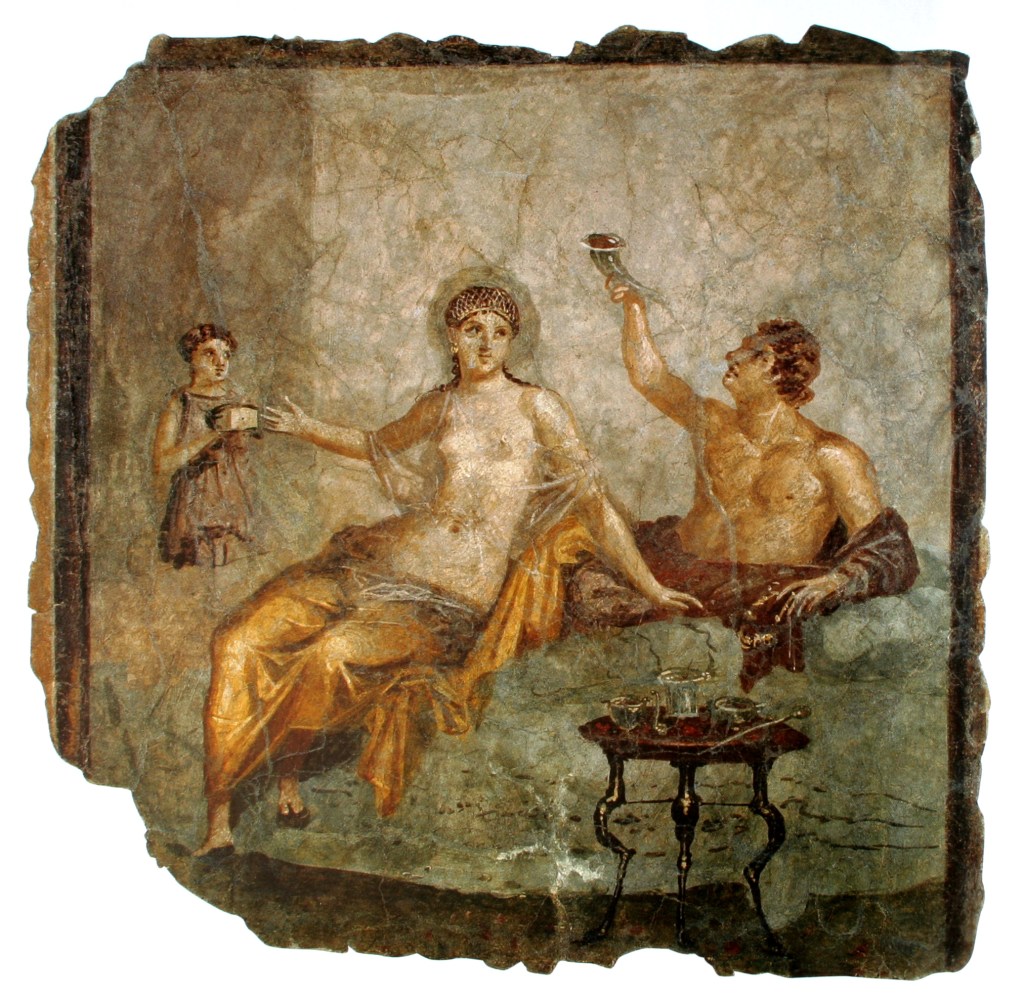
[cover image from World History Encyclopedia – Roman fresco of a Banquet scene, Herculaneum]
While the term “Silk route” has entered the vernacular lexicon, the layers of its cultural influence are still understudied. See the feature about an exhibit on Silk roads here and here. At least the usual discussion on trade segues into the economics of the trade, and the multiple axes for the goods transacted through the general area of western China, the dry deserts connecting the Himalayas, into the network of hill passes of Azerbaijan, and then finally connecting the west-Asian trade routes with the empires spread across the Mediterranean. Read more on the archaeology of Silk route here (a feature from Archaeology magazine, not an endorsement).
I had the pleasure of inviting Dr. Lisa Hughes to my class on “Gender and Sex”, and we discussed the role of nomenclature such as the “silk route” that cuts across the ideas for a geography, commodity, and also for its intangible connotations. Silk route, which is in fact a stand-in for numerous trading points and cultural diffusion, is often dubbed as the connection between the “east” and the “west” (I use these terms in double quotes as these terms also come with a loaded meaning-making surrounding culture, worldviews, etc. But more on this in later posts). Dr. Hughes also suggested different approaches to examine the early connections such as the “silk route” through the lens of positionality and presentation.
Silk through the ancient trade routes
A priced commodity such as silk, exclusively produced in large quantities (at least to the extent that it was commercially viable) in China, exchanged many hands until the silk yarns reached the then Roman empire. Caravans holding the precious cargo would weave across the desert of Taklamakan, brave the chilly winds, pass through challenging terrain such as the Hindukush, and finally join other merchant groups that travelled from different directions to exchange the merchandise. Often, the merchants from West Asia such as Istanbul and other ports would join the exchange and would carry the silk beyond Bosporus with their horses and caravans adept at navigating that landscape. The merchants from western China would then return with new goods to be sold throughout the kingdoms and principalities in the Tibetan desert, and carry some to China.
The yarns of silk would be wrapped in delicate paper, held together by hemp or flax rope, before being securely tucked into wooden boxes. These boxes, often oiled with insecticide formulae would then join the sea of merchandise that flowed from one end of the Eurasia to another. Similar boxes would be laden with perfumes teas, flowers, leaves, other textiles; some with spices, jewels, metal ingots, etc. often carried by humans. Some of the humans in such entourage would also be transacted as slaves. The stories about slavery associated with the silk route is another interesting, and understudied chapter form history, that will turn to at a later date.
Silk and Roma
These cargo that made into the Roman empire continued to be lauded as the finest import into the empire. Numerous Roman authors and poets including Vigile mention silk as one of the priced gifts from the east. Vigile also believed that silk was obtained form the trees – a clear indication of the secrecy for the origin of silk, making it an enigmatic, and coveted import into the Roman world.
What fascinated the Roman world about silk to this extent? Sheets after sheets of the delicate fabric made into the ports within the Roman empire (at least from 100BCE onwards). The frescos, most notably at Pompeii show women draped in silk, lavishing in the drawing room. These images, often portraying luxuries such as jewelry, exotic fruits, etc. would emphasize on the depiction of silk as a part of the priced possessions. Dr. Lisa Hughes, studying the interaction of gender and space in the Roman world, reflected on silk beyond the popular description as a prices textile in the then empire. Dr. Hughes encouraged the students to peek behind the metaphorical veil, and to situate the significance of silk through the narrative and the symbolic function in the ancient society of Rome.
Silk, gender and morality in Rome
Silk, as a few other studies on the topic also suggest, was priced for its ethereal look and feel, and the appeal owing to its exotic origins. Additionally, silk was increasingly associated with femininity, where the perception of silk also segued into the association with temptation. Silken robes or drape quickly became a stand-in to depict a temptress in paintings and frescos of the late-Roman period. The translucent fabric increasingly became synonymous with veiling selectively, and as enhancing a seductive appeal. The body-hugging drapes of silk were believed to highlight and accentuate the physical body, giving rise to the association of silk with female prostitutes, or hermaphrodites in the Roman imagery. On the other hand, heavy fabrics such as cotton and wool blends were depicted to veil the bodies of royalty, etc. in portraiture art of 100 BCE.
Silk as a hypersexualized drape continued through imagery and sculpture, to the point that the Han silk was banned by some of the leaders in Rome. Seneca the younger labeled silk to be amoral for women, and effeminate for men. In spite of the less favoring attitudes towards silk in Rome, the textile continued to flow in Roman markets, more prominently throughout c. 100BCE to 300CE. In Caligula’s empire, silk continued to be smuggled and sold in black markets, but the hype for the fabric did not die out. Roman authors such as Tibullus, Ovid, Horace and Propertius alluded to silk through poetry, and often called upon the textile as metaphor for delicate grace, selective and seductive veiling, etc. The visual idiom of delicate silken folds on the body of damsels, became a stand-in for feminine beauty standard that the western art world continued to carry into the Renaissance period.
The story about silk does not end here. The textile’s appeal in China and surrounding region opens a new discussion on the question of silk and sexuality. I will continue that part of the discussion in my next post. Keep reading! 🙂
References:
Benjamin, Craig. 2018. Empires of Ancient Eurasia The First Silk Roads Era, 100 BCE – 250 CE , UK: Cambridge University Press. pp. 119 – 147 [DOI: https://doi.org/10.1017/9781316335567.006[Opens in a new window]
Sericum entry (access link here) in UChicago Dictionary project
Liu, Yahao. Silk and the Roman Empire.
Frey, Richard N. 2004. The Heritage of Persia. London: Mazda. p. 151
Pliny the Elder. 1942 reprint. The Natural History. London: William Heinemann Ltd p.379
Xuanzang. 1977. The Great Tang Dynasty Record of the Western Regions. Shanghai: China Publishing,
p. 14
Suetonius. 2007 reprint. Twelve Caesars. London; Penguin Classics. pp. 179–180
 Kalemighty
Leave a comment