The history of coins (and money, more generally) in South Asia has been on my mind as I continue to read, understand, and make the interconnections between politics, religion, economy, and society in early Modern South Asia. In 2019, I had the opportunity to co-curate an exhibition on coins at the Nickle Galleries, Calgary. And my interest in numismatics rekindled from then on.
I have been thinking about the selection of specific art on coins in South Asia, especially the Mughal coins (If you don’t want to read on, please exit this tab, by all means!). After teaching a course on Modern South Asia at the University of Calgary in Winter 2025, the topic of currency of pre-modern South Asia continued to be on my mind. And down the rabbit hole, I started my explorations into looking at Jahangir’s coins beyond their monetary value.
Jahangir reigned as the Mughal emperor from 1605 CE to 1627 CE until his death. The coins issued in the span of 22 years of his reign continue to be remarkable artistic pieces, as well as the artefacts that bring in a considerable social ethos through the iconography and manufacturing of the coins. In Jahangir’s early years as the emperor, he issued a few coins with his own portrait and his father, Akbar, on the coins. The portraiture was considered a significant departure from the established norm for numismatics in the Islamic world by the 17th century CE.
While the early Islamic rulers had some floral and faunal decoration on the coins they issued, by 17th century CE, the norm in the Islamic world leaned towards Arabic calligraphy and the ruler’s legend on the coins. Select verses from the Qur’an would be a part of the standard coin issues at the time. More details on Islamic coins of the time can be found on the internet, or will write a short post on this sometime down the line. Jahangir’s numismatic issues with the portraiture, however, offer a page-turner in that history from the Eastern Europe to South Eastern Islamic kingdoms taking shape in the 17th century CE.
In my talk on exploring the Art on Mughal coins, in May 2025, I attempted to push the envelope of what we understand as portraiture on coins. With Jahangir’s portraiture coins (pictured below), I facilitated the conversation to think about the norm of the period, and what entails “breaking the mould” as it were. On one hand, Jahangir was ushering in a shift in the coinage issued under Islamic rulers, and on the other hand, adopting elements from the established tradition of coinage in South Asia since the time of Indo-Greek kings of c. 300 BCE! There are quite a few articles on portraiture on coins in South Asia, and this one from Sarmaya provides a great snapshot for the history of portraits on coins.
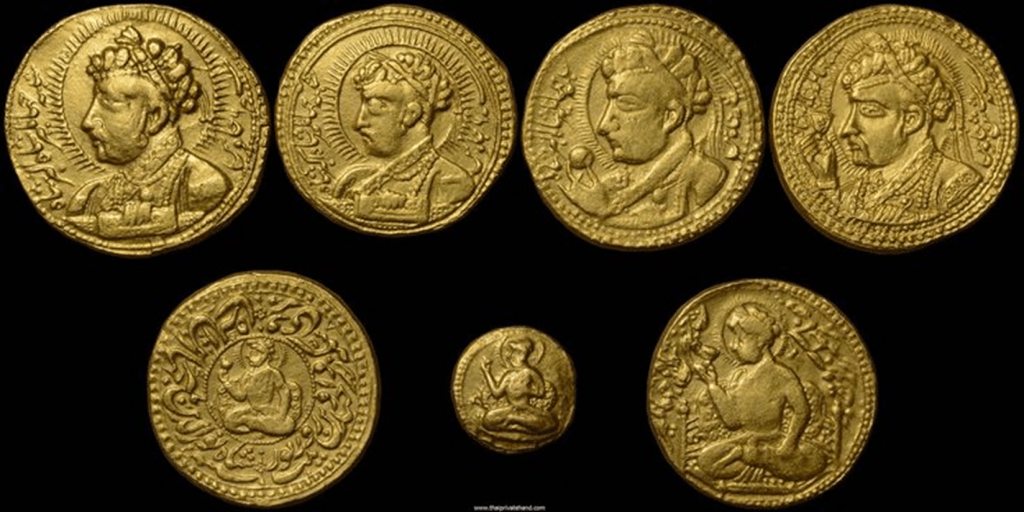
Portrait-type coins by Jahangir
Kalemighty
(image source: Ashmolean Museum and British Museum online collections)
But let us look beyond!
What is a particular trait in all these pieces? Yes – they center the patron, Jahangir in this case. There is ever so slight progression in the age of the portrait, and the likeness for painting-like portraiture is apparent in these pieces. Additionally, each coin issue depicts Jahangir in a slight different demeanor, or depicts him holding a different object. The proximity to the viewer – closer or father, depending on the size of the portrait is also an important difference in perspective. These overt elements present the coins as a portfolio for the ruler, and what each coin would have represented. Jahangir’s coins also contain couplets from prominent poetic works of the time, making the coins a living art piece, that was also exchanged for good and services! – but I digress.
I am interested in peeling another layer of these portrait-type coins. The gaze of the viewer. Why is the central figure presented on the coin in this specific manner? If we look at the first two examples (on the top left in the picture above) of coins, Jahangir is framed by the halo, the legend around the head, and — an arm rest on the bottom! This base for the portrait on the coin, also used for Akbar’s portrait on the coin issued by Jahangir, is more than mere decoration, or just a different pose.

Coin with Akbar’s portrait, from British Museum images (linked here)

The specific framing of the emperor(s) on the coin speaks to a prevalent practice in the Mughal court – that of “jharoka darshan” (lit. seeing from the window). Numerous references to the public audience of the Mughal rulers describe the emperor presenting themselves to the public through a window. The Mughal ruler would be seated by the window, with an arm resting on the window frame, or bannister, and viewing the public (whilst being viewed). The intricate robes and the headgear represented on the portraits on the coins signal to the same fervor for presenting the emperor to the public (albeit for a few minutes). With the coins capturing a similar essence of jharoka darshan, the art on the coin also curates a certain gaze. Whilst on the coin, the ruler is seemingly approachable, and maybe even personable. But the indicators such as the window sill maintain the distance between the subjects and the ruler during jharoka darshan.

Jahangir’s famous portrait also frames the emperor within the window during the jharoka darshan (pictured above). The coin thus speaks to a an important extra-numismatic element from the socio-political milieu of the premodern period. After all, a portrait on the coin is not just a mute motif, but a strategic placement of an icon that speaks volumes about the ruler, the time, and the expression of power. I will be taking this discussion further in July at a public lecture in Calgary, and draw a few themes from my public talk in March 2025 for Nickle at Noon on Jahangir’s zodiac coins. Let us continue the conversation, and thinking about the world around us with greater care.

Further Reading:
Mintage World – Passion of the King: Illustrated https://www.mintageworld.com/blog/coins-of-jahangir/
Sarmaya – History of the Mughals through coins https://sarmaya.in/guides/a-brief-history-of-the-mughal-empire-through-its-coins/
LD museum archives: https://www.ldmuseum.co.in/lesser-known-mughal-portraits-coins.php
 Kalemighty
Leave a comment