After spending a few days with the knowledge-keepers in the Stoney-Nakoda territory to the North-west of Calgary, I walked away with a sense of renewed identity for myself. No, I haven’t been given a spirit name, etc; but the sense of self comes from a renewed understanding about my positionality, our relations and relationships, and my bond with the land.
Over the past few years, I have immersed myself in reading and teaching myself about “Land-based Learning” from Indigenous perspectives in Canada. For the longest time, I was moving about the landscape as a resident “alien” (yes, I borrow this term from the immigration documents for the USA). Although the mountains called out to me, I shrugged it as my figment of imagination or romanticism. While I have always been a “water-baby”, drawn to the seas, lakes and rivers; the Bow and Elbow rivers in Alberta did have a sense of familial connection – that I chose to ignore. And it is now, that I am truly beginning to understand the interconnectedness between my sense of being and the natural world enveloping me. While I still call South Asia as my home, I am beginning to connect with the landscape here, around Mohkinstsis (the Blackfoot name for the area of the City of Calgary), with the help of the stories, philosophies, and teachings from the land that the Stoney teachers are lending me.
For my course “Religion and Environment” at the university, I focused the discussion on the inexplicable links between humans and the natural world beyond the utilitarian approach of looking at the environment. The discussion also led into the Indigenous Worldview of looking at the animals as our relatives – who breathe the same air, and highlights the symbiotic relationship between “us” and “them”. In my discussions with the Stoney knowledge-keeper this week, I was taken aback by the embodiment of this philosophy in every little detail, some of which are often ritualized and considered sacred.
Constructing the tipi
A Stoney family and a Morley knowledge-keeper constructed a “tipi” with us. The lond tipi poles sourced from the fallen trees form the neighboring areas formed the skeleton for the towering structure. The tipi was our proverbial home for the next days, and we were witness to the creation of the “space within space”. As the tipi poles were hauled up and held in place, the conical structure of the tipi began to take shape. With group effort, we held the base of the poles in place, hoisted and weaved the poled such that the intricate structure stands on its circular base formed out of equidistant poles set in a circle. Lastly, the tipi pole with the canvas was placed in one empty spot, and the canvas was drawn from both sides over the tipi pole structure to envelope the skeleton. In a sense, the animal’s skeleton was now covered with the skin, and we were ready to take shelter in its belly.
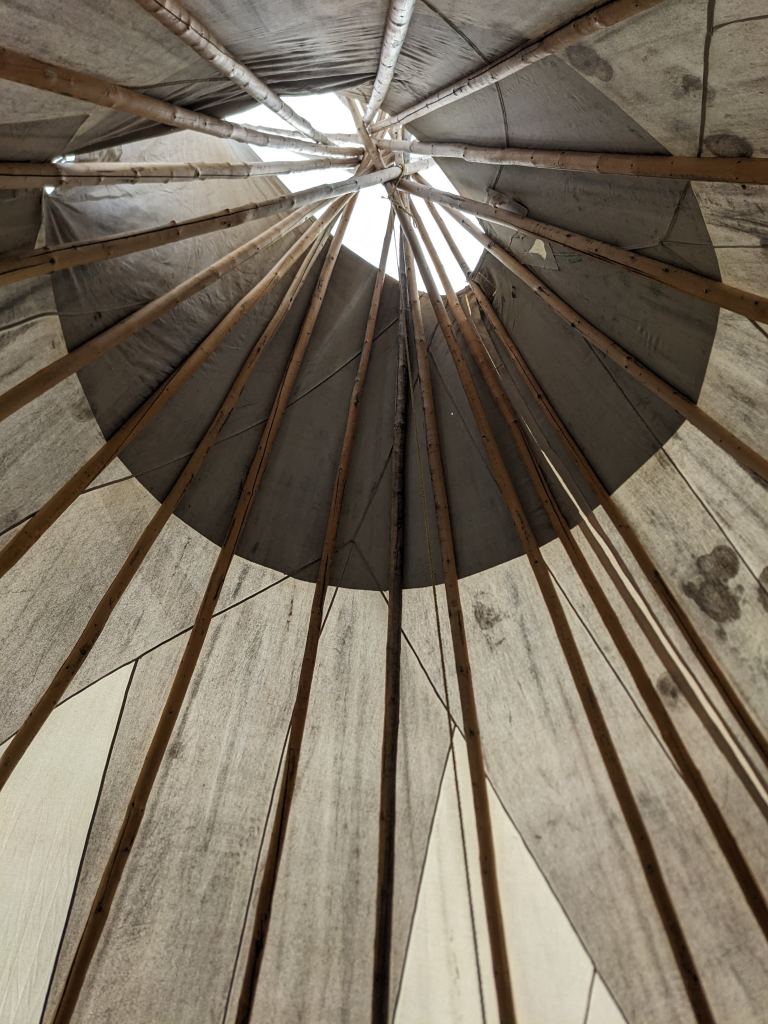
We sat in the tipi in the sharing circle – a place with no sharp angles, or nooks to hide. Just a space for open communication and heartfelt sharing. Sitting in the tipi, we talked about how the architecture of the tipi reflects the relationships. Members of the community would work together on animal hide, decorating bones and tools, making hair coats, and the like – all while seated in circles, mostly inside the tipi. The hierarchy also melted whilst sitting in a circle, as all members can see each-other, and converse with each other directly. A seemingly small tweak, but significant!
The relations with the landscape are also forged at the tipi. The canvas, the tipi poles, strings and senew – all come from the very land the tipi stands on. I was also intrigued by the discussion on animals and trees giving up their life and their shell (bark or skin) to lend themselves shelter, shields, and other objects of need and wants in the Indigenous societies. The narratives from “Braiding Sweetgrass” (cannot recommend this enough!) amplify the relationship between us and the plants. And thus, under the tipi, my search for interconnectedness goes on…

Examining the “gaze”
Romantic? Exoticised? Maybe even fetishized? What thoughts crossed your mind as I proposed changing our viewpoints to look at the interconnections around us? Or maybe you were completely on board as I suggested taking the leap to see all of us (humans, plants, animals, and the land) as a connected whole… In most cases throughout history, Indigenous thought and practice have suffered from tokenism, infantilizing, etc., and continue to grapple with what I term as “the post-colonial-colonial-gaze”.
In my case as well, one might argue that I am trying to appropriate the lessons from Indigenous thought, to appear relevant, timely, or just “viral”. On the contrary, I see the anchors in Indigenous thought in Canada tug at something I carry from home (South Asia). In my PhD thesis I talk about land rights and naming of the landscape based on Hindu deities in the Puranas. These claims and performances of naming in turn challenge the Indigenous ways of the locals in western India – termed variously as Adivasi, Vanarkshak, Makadpal, to name a few categories. In that sense, I represent the research group that has long studied/analysed the oppressor narratives for meaning-making. In the context of the British rule in India, revisiting pre-colonial literature as a touchstone for “culture” could hold up in the 80s-90s, or even in early 2000s. However, now is a real need to center the narratives of indigenous thought in the context of South Asia as well.
Growing up, when the elders around me taught me about the wild and domesticated plants in the backyard, or signaled to a certain plant’s sap to help soothe a wound when I had a fall; come together as recollections from my land-based upbringing. I was routinely labeled as a “small town girl”, and I remained oblivious to the side of me that was intimately connected with the small town – its earth, its water, and also its trash, that I remain responsible for.
Under the tipi that day, our conversations emphasized the scale and scope of indigenity and how some narratives of indigenous thought are still considered invalid, or lesser. The tipi conversations renewed my interest once again, to think of decolonization and indigenity in a new light, once again.


 Kalemighty
Leave a reply to Kalemighty Cancel reply